Way to make a Travel > World Tours > Most iconic Landmarks in London
LONDON, UK – Visitors with only a limited amount of time at their disposal should try to take in as many of the following most iconic London sights as possible. Start with a simple walk from the very centered part of London and its Westminster Abbey and take your left towards the Tower Bridge.
Westminster Abbey
It is London’s most magnificent Gothic church, scene of the coronation of English sovereigns since 1066, containing monuments to many great figures in British history. Of particular interest are Poets Corner around Chaucer’s tomb, the sumptuous Royal Tombs and Henry VII’s Chapel, one of the supreme glories of late Perpendicular architecture.

History of Westminster
Westminster was created when Edward the Confessor moved his residence here and built his abbey church on what was then Thorny island. The Palace of Westminster remained the sovereign’s principal residence until Henry VIII took over cardinal Wolsey’s Palace, York Place, renaming it Whitehall.
Westminster Bridge, completed in 1862 to designs by Thomas Page, affords an excellent view upriver of the grandiose complex of the Houses of Parliament and the wide sweep of the Thames towards the City.

Clock Tower
The clock tower, located at the corner of Westminster Bridge, is home to the famous 13.5-ton bell, Big Ben, which strikes the hour. The most famous London Landmark is named after Sir Benjamin Hall, the Commissioner of Public Works who was present when it was installed. Each clock face is 7 meters in diameter and the numerals are 60 centimeters high. At night, a light at the top of the tower indicates that Parliament is in session.
The mounted guard by the Household Cavalry is relieved every hour, and at 11 o’clock the colorful ceremony of Changing the Guards takes place.
Buckingham Palace
Buckingham Palace is located near the ever-busy Victoria Coach Station and stretches across The Mall and St. James’s Park. Built between 1702 and 1705 for the Duke of Buckingham, it was sold to George III in 1761. The palace became the monarch’s permanent London residence, when Queen Victoria ascended the throne. Every July, the palace’s vast grounds host garden parties.

Palace Rooms
The State Rooms of Buckingham Palace are open to visitors each year for two months in the late Summer. The rooms are those used for ceremonial occassion and for entertaining important guests, and they were designed to impress, with ornate ceilings, antique furniture, elaborate chandeliers and full-length family portraits.
Among the most impressive is the Picture Gallery room, hung with some of the finest pictures in the Royal Collection, including masterpieces by Rembrandt, Rubens, Van Dyck and Vermeer. Another of the most impressive palace rooms is the White Drawing Room, elegantly decorated in white and gold.
The spectacular Grand Staircase leads you into a suite of rooms which take you to the Throne Rooms, where the Queen receives guests at State functions.
Changing the Guard
The colorful spectacle of Changing the Guard takes place in the forecourt at 11.30. The Queen’s Guard troop the Queen’s color from St. James’s Palace. New changing guard is led by a military band, arriving from Wellington Barracks. The whole ceremony lasts for about 30 minutes, to the accompaniment of the band.
Away from the walking route is the Kensington, famous for the Hyde Park, numerous Colleges and Museums. It can be reached by Metro green District line or taking South Kensington Buses.

The Victoria and Albert Museum
Victoria & Albert Museum is located across the road of the Metro hub, and houses one of the world’s finest collections of the decorative arts.
Occupying a 12-acre site, the V&A houses huge collections of furniture, jewellery, statuary, costumes, textiles, musical instruments, silverware and metalwork. The museum is vast and confusing, with 8 miles of galleries, so do not try to see to much at once. At the information desk just inside the entrance you can pick up a free plan, ask about any galleries that may be closed or arrange to go on a free introductory tour.
A good place to start a visit is in the Medieval Treasury Room 43, just behind the main foyer. It is a magnificent display of European art from 400 to 1400, containing enamels, ivories, stained-glass, illuminated manuscripts and textiles.
Museum Collections
The collections are divided into two main groups. The Art and Design galleries bring together different types of art by period or geographical area. The Materials and Techniques galleries specialise in particular types of object and are mainly on the upper floors.

Trafagar Square
Trafalgar Square, famous for its pigeons, demonstrations and New Year revelries, was laid out by Sir Charles Barry in 1829-41 on the site of the Royal Mews. Its name commemorates the great naval battle of 1805 when the French fleet was defeated by the English under Admiral Lord Nelson, whose monument dominates the square. The 170ft. Monument, known as Nelson’s Column, was designed by William Railton and the 16ft. Statue of Nelson by E.H. Baily was erected in 1843.
The four bronze reliefs at the base of the column ilustrate naval battles and were cast from captured French cannon.
The National Gallery
On the north side of Trafalgar Square stands one of the world’s greatest art galleries, representing all schools of Western painting from the Italian Primitives to the 19th century. Its collections include such masterpieces as Leonardo da Vinci’s Virgin and Child with St. Anne cartoon, Piero della Francesca’s Baptism of Christ, Van Eyk’s Arnolfini Marriage, Van Dyck’s Equestrian Portrait of Charles I and the Roke by Velasquez.
Stretching south from Trafalgar Square is Whitehall, which contains many government offices. On the left are Great Scotland Yard, home of the Metropolitan Police until the end of the 19th century, and the Ministry of Defense. On the right are the Admiralty and, further down Horse Guards, designed by William Kent.


The British Museum
Probably the most comprehensive museum in the world, representing man’s most important cultural achievements since prehistoric times, from the monumental sculptures of Ancient Egypt to the perfection of Classical Macedonian Art, from the Rosetta Stone to the Portland Vase, from Assyrian reliefs to superb Medieval craftsmanship.
History of the British Museum
The British Museum was founded in 1753, with the recent acquisition of Sir Hans Sloane’s collection, manuscripts from the Cottonian Library and the manuscript collection of the Earl of Oxford.
From Bloomsbury, take a bus to Regent’s Park and then walk to Baker Street, where you’ll find the Sherlock Holmes Museum, Madame Tussauds Wax Museum and the London Planetarium.

Sherlock Holmes Museum
Baker street leads north from Portman Square. Beyond Marylebone Road its best known address, 221B, home of the fictional detective, Sherlock Holmes, has been recreated as the Sherlock Holmes Museum. It contains a recreation of the great detective’s study and bedroom, based on descriptions in the books.
Madame Tussaud’s
Return to Marylebone Road and turn left to reach the famous wax museum Madame Tussaud’s. This famous wax museum is one of London’s most popular attractions, so be prepared to queue to get in. On display are many famous historical figures, and a constantly updated array of today’s celebrities, from rock stars of politicians.
The Chamber of Horrors is particularly popular, with its serial killers and simulated executions. Next door is the Planetarium which offers regular shows about time and space.


A self-portrait of Madame Tussaud can be seen in the entrance hall. She began her career making wax figures at the court of Louis XVI in France and after the outbreak of the French Revolutionmade death masks of victims of the guillotine, some of which are still on display.
The City of London
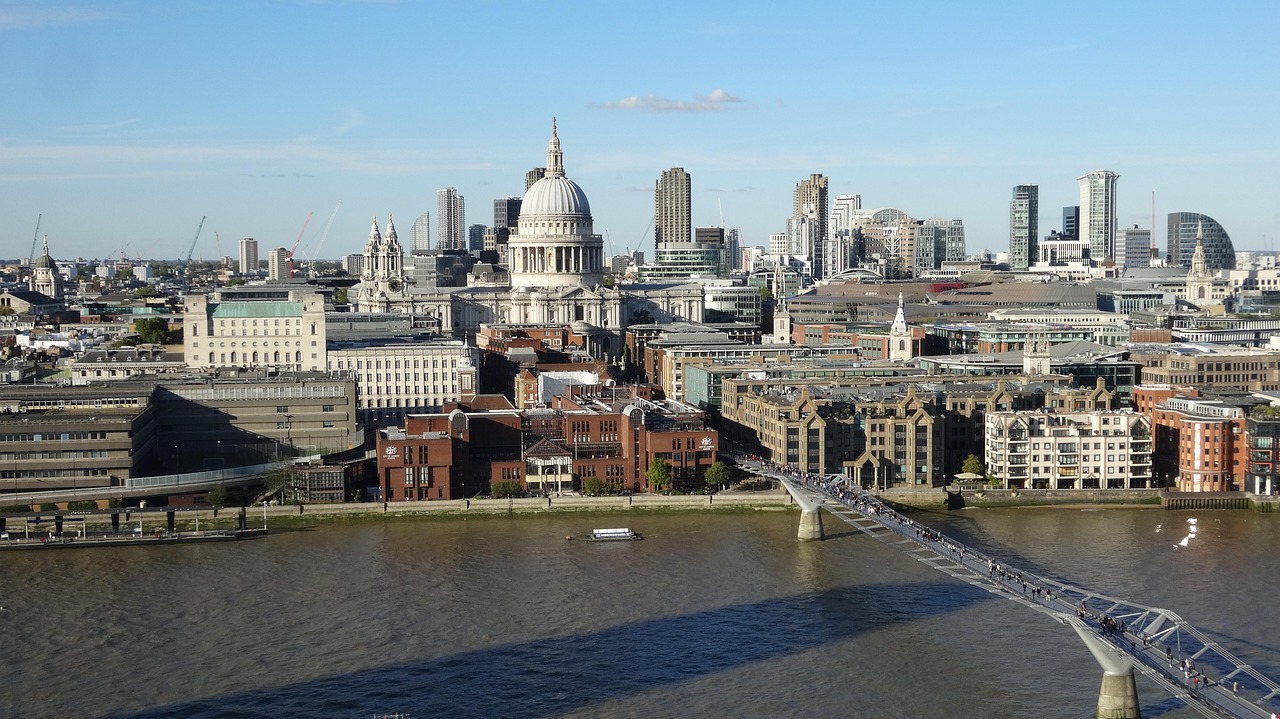
The City of London is also known as the Square Mile, as this is approximately the area it covers. This is the oldest part of London, preserved as it was here that the Romans founded their city of Londinium nearly 2000 years ago. It is also the most modern area of London, with the latest building a rubbing shoulders with Medieval churches and stretches of Roman wall.
The City is a great financial center, on a par with New York and Tokyo, and is home to many banks, insurance companies and other financial institutions.
Sir Christopher Wren designed many new churches after the 1666 Great Fire that devastated London, many of them survived the bombs of the Second World War. Of these, the masterpiece is St. Paul’s Cathedral at the top of Ludgate Hill.

St. Paul’s Cathedral
The present building is the masterpiece of Sir Christopher Wren, who made it the focal point of his network of City churches built after the Great Fire of 1666. The majestic dome is one of London’s best-known landmarks and its galleries afford superb views over the City. The sumptuous interior contains the monuments and tombs of many famous figures, including Wren himself, Wellington, Nelson and John Donne. The Whispering Gallery is famous for its curious sound effects.

Tower Bridge
Crossing the Thames to the west is Tower Bridge, with its twin towers and massive bascules which are still raised occasionally to allow the passage of tall ships.
Tower Bridge was built from 1886-94 to the plans of Sir Horace Jones and Sir John Wolfe Barry, and was designed in such a way as to blend with the Tower of London. The bridge is now open to the public, and there are exhibitions on its history as well as superb views from the walkway.
To the east of Tower Bridge on the north side are the St. Katharine Docks, constructed in 1827 by Thomas Telford but now converted into a yacht marina and leisure center.
This place is an attractive area to wander in, with shops, restaurants, a hotel and the Dickens Inn Pub. There are also a number of interesting boats moored here, including the Thames sailing barges.

Tower of London
Since the time of William the Conqueror, the Tower has served as a fortress, royal residence, treasury, mint, menagerie and prison. Guarded by Beefeaters or Yeomen Warders, the complex of walls, towers and other buildings is arranged around the original core of the White Tower built by William I. It contains collections of arms and armour, the Crown Jewels, St John’s Chapel, Traitor’s Gate and Executioners’ Quarters.
A pleasant walk along the River Thames from London Bridge to Westminster Bridge offers magnificent views of the South Bank.
Shakespeare’s Globe
On the bank side of River Thames near the Blackfriars Bridge is where the stunning recreation of the Globe Theater is located. Place where many of Shakespeare’s plays were first performed. It was built to the original design and using traditional materials and methods. Plays are staged here much as they were in Shakespeare’s time, with no proscenium arch and little scenery, and there is more audience participation. Tours of the theater are available.
Our Favorite London Tour
Wendy_G, Oct 2025
London 30 Top Sights with Fun Local Guide
” This tour gives a nice overview of the top tourist attractions in London. Even with it raining, our guide, Mark, was very entertaining, easy to hear and understandable. He offered interesting historical facts and stories you probably wouldn’t get in the history books! Unfortunately, due to the rain, we were not able to witness changing of the guards, but they still paraded down the mall. I would definitely recommend!”
Read more about – London 30 Top Sights with Fun Local Guide”

Great location – friendly staff – Excellent stay – Booking hotel in London by Trivago


👉For latest holiday best hotel offers in London visit our Partner booking links here⤵️
Promotion:


Keywords: @London landmarks @bhilondon @bhieurope @bookinghotelin @waytomakeatravel @bhihotels @bhicruises #londonhighlights @bhitours #bookdirectly @bookdirectly @promotions #booking hotel in london @hotels in london #londonattractions #museumsinlondon #accommodationinlondon #londonhotels #bookinghotelinlondon #Most iconic Landmarks in London
Other similar stories: Trendsetter city Vibrant Scandinavian capital city Creative Stockholm Gateway to the North Sea
Home Travel stories World Tours About





















Leave a Reply