Way to make a Travel > Travel stories > Destinations >French Riviera places to visit
The French Riviera, which spans from the Italian border to the western side of the Var administrative district, is ideally located between the sea and the mountains. The French poet Stephen Liegeard originated the French term for the Riviera, ”La Côte d’Azur”, literally the Azure coast, almost a century ago. However, it is a veiled word that conceals the astonishing variety that characterizes this region of France.
Why should you visit the French Riviera?
Rich History
The historical variety of the Côte d’Azur area allows the traveler to journey from prehistoric sites to medieval castles, from Roman ruins to hilltop perched villages, from Romanesque churches to more recent works. Its geographical variety offers sumptuous landscapes from the jagged, multicolored rocks of L’Esterel through long, apparently languorous bays and cliffs that give way to the cornices of Eze, Menton or Cannes, up through the countless, steep-sided valleys of the Nice hinterland.

Environmental variety takes in large, busy, commercial towns, along with well-preserved villages that have witnessed an intense and rich history; it goes from the jovial, bustling, crowded market of Cours Saleya to the huge open spaces of the Mercantour Park, a paradise for chamois, marmots and nature lovers.
Mild Climate
The French Riviera has the nicest year-round climate in France, with typical summer temperatures well above 30 °C (80 °F), long dry summers, warm springs, autumns, and moderate winters. Its varied climate allows visitors to dangle their feet in the deep blue sea, while contemplating, in the distance, the snow capped summits of the winter sport resorts of Auron, Isola 2000 or Valberg.
Variety of vegetation
The variety of vegetation combines the scents of aromatic herbs and the perfume of mimosa, rose, jasmine or lavender with that of the astonishing species collected together in exotic botanical gardens. Nor must we forget to mention the softly swaying palms, the parasol pines, fiercely clinging to the rocks; the hustle and bustle of the little towns, the quiet of the villages; or the smooth cascade of streams over solid rock. All of this is combined with the flavors of an enviable cuisine based on thyme, olive oil, garlic and basil bathed in the myriad golden rays of a generous Mediterranean sun.
Photo Galleries
Cannes


Nice


Monako


Which places to visit in French Riviera?
Menton
Menton is a French Riviera border town to the east of the Maritime-Alps, and it is the last place to visit before entering Italy. This community is well-protected from the northern winds and is the warmest resort town on the Riviera, making it a very popular destination for older people. Its tropical climate in summer is ideal for growing oranges, mandarins, and lemon trees, and the citrus groves around this south French community cover the terrain completely.

The most representative place to visit in Menton is the Baisilique de Saint Michel Archangel constructed in the 17th century. In the heart of the church can be found a 16th century altarpiece by Andre Manchello and numerous objects of art, such as an 18th century statue of Saint Michel in polychrome wood. Another place to visit in Menton is the Chapelle des Penitents Blancs and Hotel de Ville (Town Hall) whose wedding salon was decorated by the painter, poet and dramatist Jean Cocteau. The Museum of Jean Cocteau with a fine collection of tapestries, drawings, watercolors and oil paintings of great value, can be found in a 16th century fortress.
Musee Municipal is also very interesting place to visit in Menton. The ground floor is dedicated to archaeological finds, which include the skull of a Cro-Magnon Man, while the first floor has an important collection of paintings.

Another tourist attraction is the Jardin Botanic et Exotique ( Botanical Gardens) in which there is a profusion of all sorts of Mediterranean plants. During the Carnival period, Menton becomes the center of a series of over the top activities attracting numerous tourists, particularly while the Citrus fair is on. During this fête, in the gardens of the Bioves, there is a magnificent exhibition using only citrus fruits for decoration. Participants are given a theme and then try to outdo each other in originality and artistry.
On the Sea front, parades are organized using floats decorated solely with lemons and oranges. It is a spectacle that is full of life, color and light, especially striking for the incredible contrast between the blue sky and the yellow and orange of the citrus fruits.
Eze Village
Some historians have claimed that the name of this village is derived from the Egyptian Goddess Isis, while others have insisted it comes from the term visia or Avisiam, which the Romans gave to look out posts on high vantage points. Perched upon a rock, 427 meters above the sea, this town, fortified by Caesar, is a veritable eagle’s nest.
This ancient agricultural village, which at the beginning of the 14th centurywas a Guelph stronghold, saw its castle dismantled in 1706 under the orders of Louis XIV. Narrow, sloping streets, giving the village a picturesque air, lead the visitor down to the Chapelle des Penitents Blancs and to the Eglise which is well worth place to visit.

Fragonard Perfumery
Following the moyenne corniche between Nice and Monaco, suspended above the sea, near the entrance to Eze lies a modern factory, surrounded by a beautiful garden of fragrant plants. This highly-functional facility presents the main stages of the perfume manufacturing process and uses leading-edge production means.
This story began in Grasse, in 1926, when Eugene Fuchs opened a perfumery, in homage to the famous painter Jean-Honore Fragonard. From father to son and son to grand-son, the business developed rapidly and the original factory is now spread on three different sites, which are all open to the public.
With a free guided tour of Fragonard laboratories, workshops and packaging rooms, visitors will discover how their products are created.
A Perfumer is a connoisseur of thousands of products, each with its own characteristics, smells and colours. His imagination, creativenessand knowledge of accords enable him to create a virtually infinite number of compositions.
Fragonard cosmetic laboratory


Cap D’Ail
A commune created in 1908, the Baron de Pauville had previously launched Cap D’Ail as a Spa town in 1879. Terraced upon the lower slopes of the Tete de Chien Mountain the commune extends down to the edge of Monaco where a footpath, along the coast, can be followed into Monaco itself. A renowned tourist resort, Cap D’Ail is surrounded by well-preserved countryside, fissures, cliffs and footpaths, bathed in exultant fragrances from hundreds of pines, eucalyptus, rock-roses and sycamores.
Of particular note is the open air Jean Cocteau Theater, a must-see place to visit, decorated with three fine mosaics by the artist.
Saint-Jean-Cap-Ferrat
This French Riviera place to visit is a peninsula covered with pines and olive trees on which luxurious residences and properties, such as that belonging to Leopold II of Belgium, have been erected. The Palais Rose, constructed between 1909 and 1912 in an Italian style, was bequeathed to L’Institut de France pour l’Academie de Beaux Arts by the Baroness Ephrussi de Rotschild in 1934. Here to be admired is a marvelous collection of art from the 16th to the 19th century; a collection of porcelain from Sevres; of royal tapestries from Savonnerie and of 18th century furniture, some of which belonged to Marie Antoinette.
The gardens surrounding the villa museum are in every way remarkable and on summer evenings become the scene for numerous theatrical events, concerts or conferences. The principal garden is in the French style the others are in a variety of styles.
Cannes
Cannes is built on the site of an old Ligurian city, on an elevation that slopes down to the shores of the Gulf of Napoule, with the Massif of L’Esterel in the background.
This charming piece of French Riviera, shaped by its surrounding hills, has a very pleasant climate all year round.
Among the prominent festivals hosted here, the International Festival of Cinema is undoubtedly the most well-known festival, contributing to Cannes’ status as one of the world’s most popular tourist destinations.
The origins of the city are little known, since it languished in obscurity for centuries until 1834. That was the year that Lord Brougham, who was the British Lord Chancellor at the time, was en route to Italy when a cholera outbreak there forced him to make an unscheduled stop over in Cannes.
Impressed by the mild climate, the blue of the sky and the beauty of the site he decided to build a winter residence there and numerous British aristocrats followed his example. Lord Brougham obtained the funds needed to build a dike besides the old town from King Louis Phillip.
The town continued to grow from then on until it became the world-famous resort it is today. During the first half of the 8th century, the Saracens invaded the Cannes region and held it for many years.


Later in the 18th century, Cannes was completely destroyed after having suffered several raids by Arab pirates, an invasion by the troops of the Duke of Savoy and finally that of the Austrian army. In 1815 Napoleon escaped from the Isle of Elbe and landed at Golfe-Juan. A small troop of 40 grenadiers, under the command of Cambronne, then occupied Cannes and Napoleon, hidden among the dunes, was obliged to bivouac near the Chapele de Norte.
Historically, Cannes was always closely linked to the Lerin Isles and through diverse tourist links it still is. The tourist offer includes pleasure trips around the islands, especially frequent in summer and wonderfully artistic ‘Sound and light show’. A narrow strait called the ‘Plateau du Milleu‘, which is largely frequented by private boats, separates the two Islands.
In 1858 Prosper Merimee, an inspector of historic monuments toured the Lerin Isles and noted the importance of Cannes and its surroundings. After Miremee thee appeared Guy de Maupassant, Toqueville, Thiers, Stephen Liegards as well as many other personalities from the world of arts and letters. From this period on, Cannes became one of the favorite haunts of artists, rich bankers, aristocrats and high-class tourists.
The modern image of Cannes is well known throughout the world. Its famous festivals of recorded music in January and of cinema in May concentrate the attention of music and cinema lovers worldwide on the city. Numerous congresses are held here and Cannes tourism is intense throughout the year, making Cannes a fashionable resort of truly international proportions. The city also offers extensive leisure and sports opportunities allowing the visitor to play hard too.
Cannes stretches some nine kilometers from the La Bocca district to the rocks of the Fourcade. From the harbor the town presents a wonderful panorama. The city is centered on the Rue d’Antibes, the Allees de la Liberte and especially on La croisette. A really cosmopolitan boulevard, these three kilometers promenade around the harbor goes from the Old Port and the Palais des Congres, built on the site of the old municipal casino, to the tip of Palm Beach, where the modern Casino d’Ete and the Port Canto can be found.
A walk along the boulevard presents quite a spectacle in itself, performed against a backdrop of the sea, golden beaches, swaying palms and a profusion of flowers. La Croisette has become a true symbol of the rapid expansion and new-found vocation of Cannes.

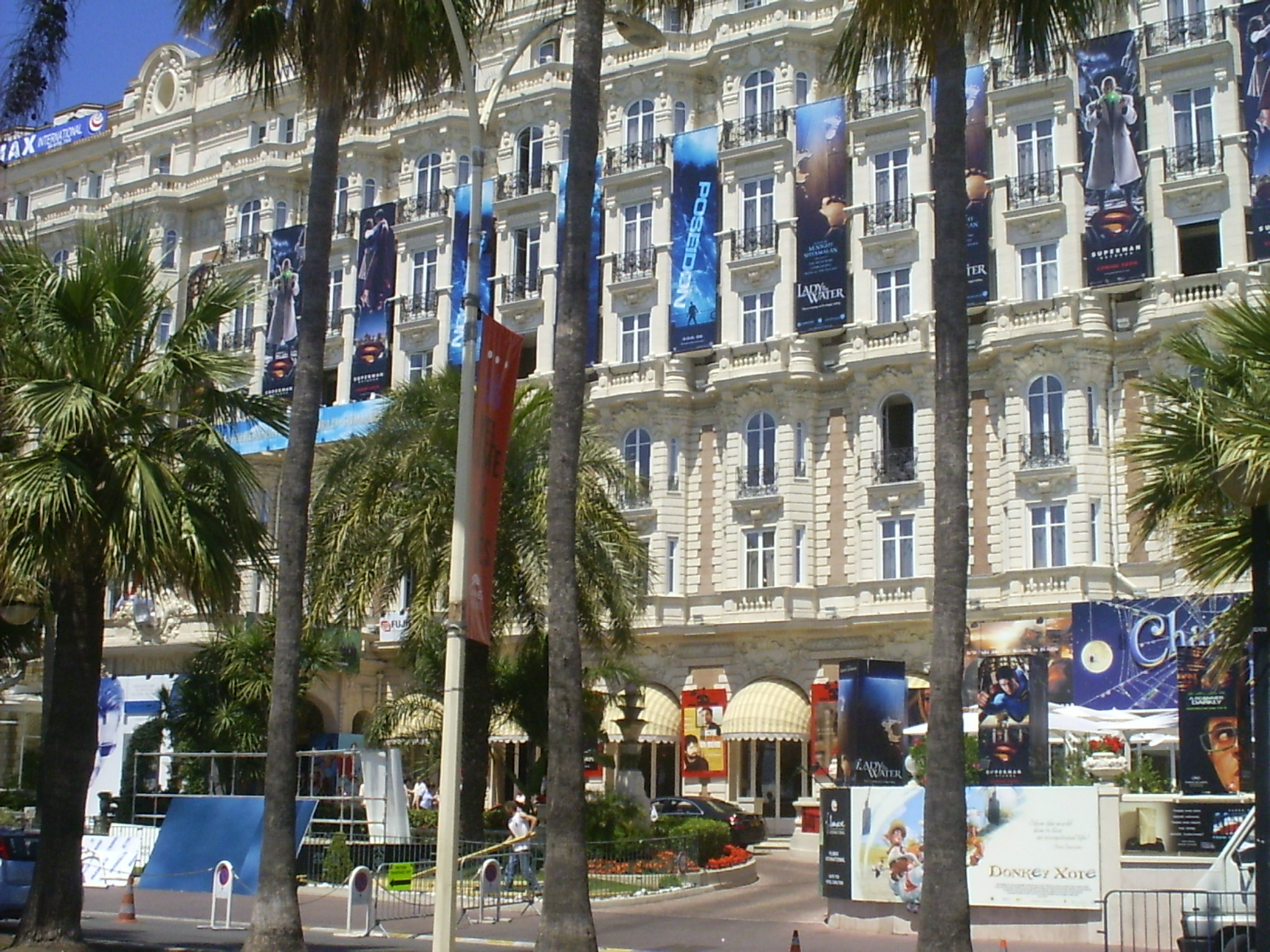
The Palais de Congress area of the boulevard concentrates together several luxury hotels such as the Carlton of the Majestic, opulent residences and fashionable name brand boutiques. Truly this vast explanade reclaimed from the sea and planted with pleasant gardens, is the best trump card the city holds.
Cannes extends to the north, along the Boulevard Carnot, as far as Cannet to the west up to La Bocca along the boulevard Jean Hibert, which takes in the Plage du Midi, and to the east, past the luxurious mansions lining the beautiful avenues of the residential areas known as La Californie and Cannes Eden.
Running parallel to La croisette, the Rue d’Antibes is an important commercial center with magnificent stores, while the Rue Meynadier displays its bustling dynamism to the world through its colorful and spirited window displays. In the center of the city there is Le Suquet hill, the ancient bulwark of Cannes where streets and houses cluster around the slopes of Mount Chevalier. Le Suquet has the intimate, quiet and peaceful feel of a village in great contrastto the busy modern city beyond.

The 22-metre-high Suquet Tower is the building which best represents old Cannes. Fidhermen had always used it as a reference point when navigating around the coast. There is magnificent panoramic view over Cannes available from the ancient walls of Le Suquet. Overlooking the old port, Suquet is criss-crossed with charming crooked streets such as the Rues Mont Chevalier, Sant-Antoine, La Boucherie, Le Pre or Saint-Dizier. Among other places to visit in Cannes are Church of the Lady of Hope, Place de la Castre, The Castre Museum, the Old Port.
St. Marguerite Island
The island of Sainte Marguerite, 900 m across and 3 km long from east to west is the larger and the higher of the two islands. Except the Domaine du Grand Jardin, Sainte — Marguerite belongs entirely to the state. The isle is wooded with pines and eucalyptus and crisscrossed with enchanting paths. It harbors a charming little fishing village with a few shops.
Saint Honorat Island
The island of Saint Honorat, 1500 metres long by 400 meters across is very dense in pines, laurels, vines and flowers.
For eight centuries, from 575 AD, the isle was the seat of the Benedictine monks who governed Cannes and region. Today the monastery, which suffered numerous attacks throughout the history, is home to some Cistercian Monks. Although there are some Romanesque chapels on the island, the most important architectural feature is the Castle.
Rectangular in layout it was built as a prison fort, in the 11th century, on the site of an ancient Roman well. The Monks of the Lerins took refuge here from the attacks they were subjected to over the centuries. The modern monastery was built in the 19th century and is surrounded by the old buildings once occupied by the monks.
The museum has fragments of Roman Christian engraved stones found on the isle along with documents pertaining to the monastery’s history and organization.
On 1834 the last few houses to the west of Cannes marked where the dunes and pines began, there was nothing beyond them except the Chateau de la Bocca and the Chapel of Saint Cassien. Then in 1855 the glazier Joseph Barthelemy moved into the area and started off the urbanization of La Bocca.
Today it is an important commercial and industrial area with mechanics, workshops and a shipyard. Urban development in the area has been rational and allowed for the creation of districts that are more like villages such as Frayere, Bosquet, Fouery and Croix des Gardes.

Mandelieu – La Napoule
Mandelieu la Napoule has had many names the Romans called it Mantolvocus, Mandolocas or Mandullocus, thought it did not acquire its present name until the Middle Ages. Eucher, the lord of Mandalieu a generous and civilised man, liberated his slaves around year 400 and distributed a large part of his gameoods among the peasants of his fiefdom. In the 18th century, Arab Pirates destroyed the town completely.
Some inhabitants refused to take flight and stayed to rebuild the village, founding in 1706 the Capitou. In 1782 a bridge across the Siagne was built. At the end of the 19th century, a cork works was opened in nearby Termes that doubled the population.
Mimosa, and Australian plant that was imported and acclimatized by the celebrated horticulturist Gilberd Nabonard, who was from Golf Juan, made a significant contribution to the local economy. Mandalieu was opened out towards the sea by the building of a port at La Napoule, some 7 km from Cannes.
The Lords of Villeneuve built the Castle of Napoule, on a rocky outcrop, in 1390. Raymond de Turenne later destroyed it leaving only three massive square towers and their battlements. In 1919, it was rebuilt by the American Sculpture Henry Clews and currently houses the work of this artist.
La Napoule has become a great tourist centre due to its wide sands and its spa, which remains open in winter.
Forming a balcony that is largely open to the sea, Theoule has found a niche for itself among a chain of hills covered in greenery and flowers. Dependent on Mandalieu until 1929, in is now an autonomous commune. Its four leisure ports can welcome up to 1000 boats and its beaches stretch a full 10 km. There are also some 100 km of footpaths though the surrounding countryside, which notably includes the Forest Park of Eagle Point. Theoule’s offer to the visitors could perhaps trump many of its more celebrated neighbors.
Not far from Theoule’s is the curious village of Port la Galere. Designed by the architect Jacques Couelle, the village was built on a wooded site and perfectly integrated into the surrounding cliffs.
Villefransche-Sur-Mer
Six kilometers from Nice, Villefransche-Sur-Mer is one of the most well protected and picturesque ports on the French Riviera. The town has maintained an air of authenticity with its multicolored houses, typical of the area, clinging to the flanks of the mountain; its stepped passageways, its tortuous streets descending to the sea, or its winding Rue Obscure close to the port. Of equal note is the Citadel and Saint Peter’s Chapel, decorated by Jean Cocteau and well worth a detour.


When is the best time to visit the French Riviera?
The ideal months to visit the French Riviera are May, June, July, and September. August is normally extremely congested because many people in France enjoy their vacations at this period. Visiting during the shoulder season may also be a nice alternative, as accommodations are cheaper.
Where to stay in the French Riviera?
The greatest places to stay in French Riviera are the old town centers or the promenades on the first seafront. Those are the costly options. If you are traveling on a tight budget, the peripheries of the old towns or the neighborhoods near the train stations will undoubtedly be less expensive. If you are searching for a nice, cozy and modern hotel, apartment, hostel or villa we suggest you to check the list of French Riviera hotels with their updated booking hotel compare offers where you can explore and choose the one that best suits your needs.

The 4-star Welcome Hotel Villefranche-sur-Mer has 35 rooms with stunning views of the Fishing Harbour. This pet-friendly hotel, located near Chapelle de Saint Pierre des Pecheurs and Rue Obscure, offers activities such as canoeing, hiking, and mini golf. The property is close to a boat port and a 10-minute drive from Passable Beach Parking.
Great location – Friendly staff – Excellent stay – Booking hotel in French Riviera by Trivago


👉For latest holiday booking hotel in French riviera offers visit our Partner links here⤵️
🌐BOOKING HOTEL IN FRENCH RIVIERA BY TRIVAGO
BOOKING HOTEL IN recommends Carlton Cannes a Regent Hotel – This world-class 5 star hotel is located on the famed Croisette Avenue in Cannes, between the Cannes Palais des Festivals and the retail district. It provides amazing views of the Mediterranean Sea. The Carlton Cannes Regent boasts ten spectacular suites on the seventh floor, each named after a great cinema actor.
Subscribe to our newsletter and get a fresh insight of lovely hotels, villas, wonderful destinations and things to do.
All emails include an unsubscribe link. You may opt-out at any time. See our Privacy Policy.

Promotion:


Keywords: #french riviera #menton #eze village #jean cocteau #placestovisitinFrance #Francetouristattractions #wheretostayinfrenchriviera #bookinghotelincannes #waytomakeatravel #french #Cote d’ Azur #Mandelieu la Napoule
Other similar stories: Nice Highlights 8 Paris Highlights
Home Travel stories World Tours About








































Leave a Reply