Way to make a Travel > Travel stories > Uncover the Rich History of Kavala’s Old Town
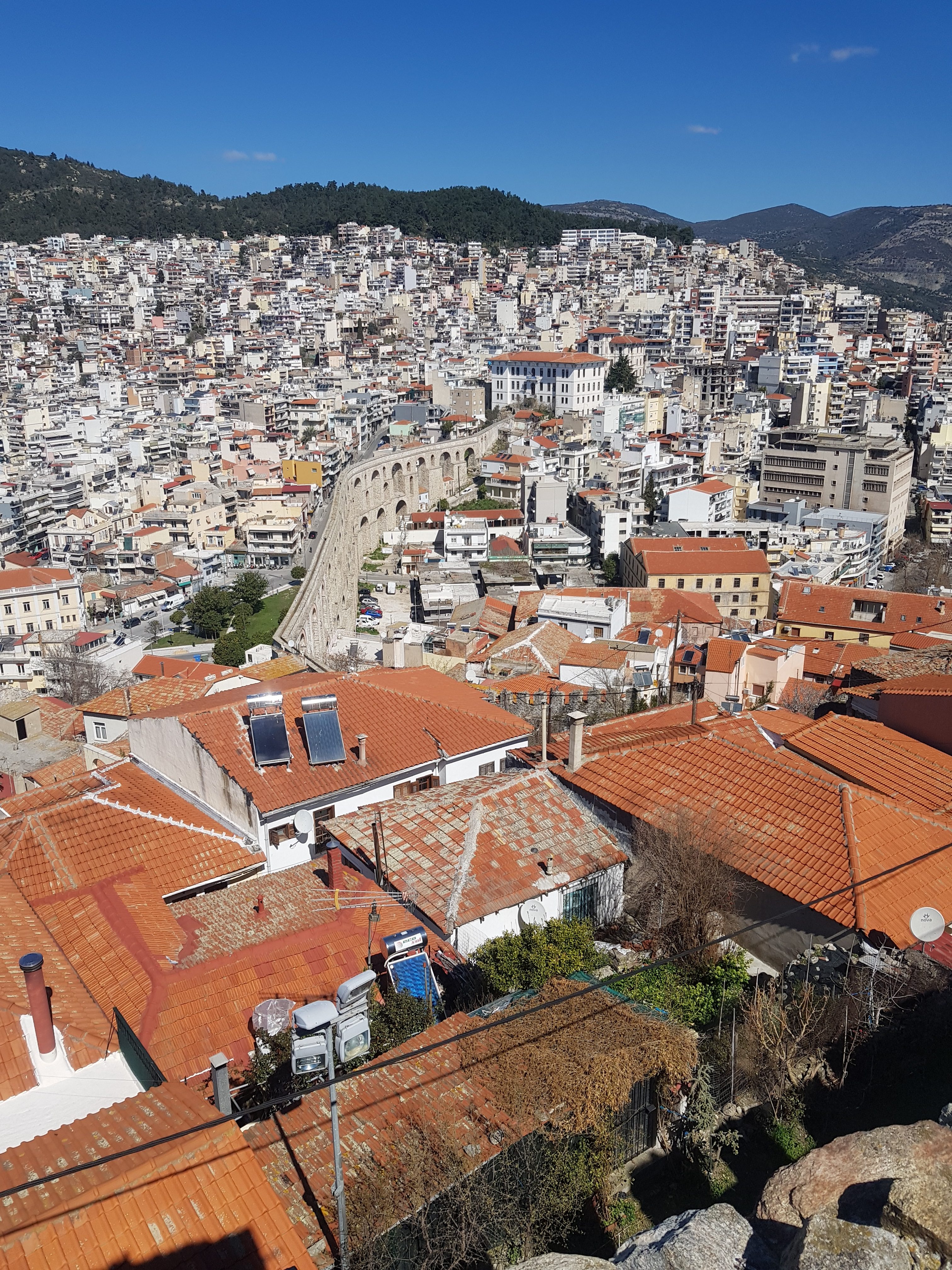
A small peninsula supports the old town and its castle, while the houses of the new town climb steep slopes. Almost always clearly visible, the island of Thassos, over 1000 meters high, floats in the blue water. Many fishing boats bob in the harbor, and beaches are easily reached by the city’s bus lines. Despite this, there is hardly any tourism here. You can easily spend a whole day mingling with the 700,000 locals.
The golden age is over
So for now, only the standard route remains for visiting the remains of the once prosperous ancient port city. From the motorway, at the traffic lights, turn left and drive 1.7 km to the freely accessible monumental lion sculpture, reconstructed from fragments found here. It is considered a monument to a local naval hero from the time of Alexander IV of Makedon.
Back at the intersection, turn left uphill and then follow the signs to the Archaeological Museum. From there, a signpost leads to the excavation site on a hill with the foundations of early Christian basilicas.
At the foot of the village hill, accessible via the road towards Serres, lies the Archaeological Park, with freely accessible remains of the city wall and defensive towers scattered throughout the river landscape. A little further north, just off the road to the right before Nea Mesolakia, lies the burial mound formerly known as Kastra Hill, whose identity remains unknown.
Kastra Hill
Mother Olympias? Or perhaps at least Alexander’s friend and general Hephaestion? Analyses of the bone fragments revealed only one thing with certainty: they belong to a woman around 60 years old, two men between 30 and 40, a toddler, and an unidentified individual.
Regardless of who the tomb was built for, it is and remains a significant archaeological find. Consequently, many millions of euros are now being spent to prepare it for visitors. These works are expected to be completed and the tomb opened to the public no earlier than 2021. Until then, the construction site can only be viewed from the outside.


Old Town Sightseeings – Greetings from the Orient
Medieval walls still largely encircle the historic city center on a rocky peninsula. A mighty fort from the Turkish era watches over everything. A stroll through the old town begins at the corner of Odos Koundourioti and Theod. Polidou, a few steps above the harbor, Platia Doxa.

Mosaic
Opposite the confluence of Polidou and Koundourioti streets, a large mosaic with a magnificent gold background, created in 2004, immediately catches the eye. It illustrates several lines from the New Testament Acts of the Apostles, the departure of the Apostle Paul from Troy in Asia Minor, and his arrival in the ancient city of Napolis, present-day Kavala.
Imaret
Kavala’s most beautiful historical building is a large Koranic school founded by Muhammad. Its three courtyards and numerous domes of varying sizes evoke memories of the Alhambra in Andalusia. Until the end of Ottoman rule, this imaret developed into the most important Ottoman educational institution in the Balkans. Then as now, it is owned by an Islamic religious foundation based in Egypt, which has leased it long-term to a Greek hotel company.
That’s why the Egyptian flag flies at the entrance. The company has sensitively restored the imaret, which was threatened by decay, and transformed it into a luxurious hotel straight out of 1001 Nights. The former mosque now serves as a stylish reading room, the hammam is, of course, a wellness center, and the rooms and suites are furnished in an exclusive Turkish style that Scheherazade herself would surely have appreciated. The cafe, bar and restaurant are also open to non-hotel guests.
Halil Bay Mosque
Little further away towards the top of the hill is where the Halil Bay Mosque is located. A three aisle basilica was excavated during the restoration of the mosque. The basilica features a semi-circular apse on the east side and a narthex on the west. The first phase of the church could be dated towards the end of the Early Christian Period, when the town was still named Neapolis. In the middle Bysantine era the Church has been refurbished at least once. Its fortification is reinforced, and it becomes a major port station on the seaway to and from Constantinople. After the conquest by the Ottomans towards the end of the 14th century the site is taken over and attributed to Muslim worship and education.


Main Church of the Old Town
Continuing uphill following the street, you inevitably come to the main church of the Old Town, dedicated to the Panagia. Its interior is completely decorated with murals in the traditional Byzantine style. The numerous depictions of New Testament events are easily recognizable.
Fortress
Finally, there is the fortress, built by the Ottomans in 1425 and rebuilt several times since. It rises in the highest, quietest spot in the Old Town, on the site of the ancient acropolis of Neapolis. The 18-meter-high keep, the heart of the castle, and the large storeroom are particularly impressive. It is a beautiful sight to gaze from its walls over the city and across to the island of Thassos.


Aqueduct
Clearly visible from the fort is the impressive aqueduct, up to 60 meters high, which, since 1550, has spanned a valley with double-tiered arches, channeling spring water from the opposite mountain into the old town.
The Aqueduct of Kavala, commonly known as ‘Kamares’ or Arches, is the last and most impressive part of an extensive water supply system originating about 6 km north of the town. The medieval aqueduct of Kavala was built to convey spring water from the foot of Lekani mountains to the rocky peninsula of Panagia, where the ancient, byzantine and medieval town of Kavala was developed.
The trail that connects the settlement of Panlaia Kavala with the town of Kavala, almost 10.5 km long, highlights the less known part of the aqueduct, the open pipe which was transporting water to the town, passing through the arches.
Easy and accessible, the trail passes through a typical Mediterranean landscape with kermes oak, junipers, elm, maple and hornbeam. Constantly twisting, it goes along streams with dense vegetation indicating water abundance in the region.

New Town Sightseeings – Blue Haze
In the harbor, numerous fishing boats and cutters bob gently, and just beyond them stretches the modern center of Kavala. On the landward side, it is bordered by stately villas and enormous tobacco warehouses dating from the city’s golden age between 1864 and 1929.
During this period, Kavala was the most important trading metropolis between Constantinople and Solun. Its rise began in the mid-19th century with increased foreign interest in purchasing tobacco. Soon, new tobacco drying facilities and warehouses were built. The job opportunities attracted Greeks from other parts of the country still under Turkish occupation.
The settlement of Macedonians outside the medieval city walls, permitted in 1864, led to the city’s expansion. Wealthy Greeks, Turks, and foreigners built magnificent villas, and even a Roman Catholic monastery was founded. However, with the widespread adoption of Virginia tobacco in Europe, tobacco production almost completely ceased after World War II. Many former workers from the tobacco factories went to other European countries as “guest workers.”
Dimotiki Kapnothiki
The starting point for a tour through the most beautiful part of the new town is Platia 28 Oktomvriou. The first stop is Dimotiki Kapnothiki, the city’s tobacco warehouse, restored in 1995 and effectively illuminated in the evenings. An Islamic merchant had it built in 1910 in the Ottoman Neoclassical style.
The blend of Western and Turkish architectural elements is striking. Today, the museum offers insights into the city’s history and displays works by Turkish artists. The monument in front commemorates the communist trade union movement of tobacco workers.
Lazariston Monastery
Quite magnificent, what the tobacco barons once built for themselves. Several particularly impressive villas stand along Kiprou Street. The Lazariston Monastery is also striking. The building complex, constructed between 1888 and 1892, initially housed a Roman Catholic monastery and later the French consulate.
The Lazarists are an order founded in 1625, named after their first mother house, Saint Lazare in Paris. Their mission is to proclaim the Gospel to the people with low-income, and they currently have about 4,000 members.
Tobacco Museum
The Tobacco Museum, though somewhat old-fashioned, is nonetheless very interesting and provides information about Kavala’s history as a tobacco city, as well as the cultivation and processing of this nightshade plant. It is housed, quite authentically, in a former tobacco factory.


Goddess with Lipstick
Right in the first room, two terracotta statues of a goddess from the 4th century are remarkable, located in the center of the right-hand wall: Her red lips, neck, and arm ornaments are painted on.
Also of exceptional quality is a limestone sarcophagus whose painted inner lid depicts two mourning women in a house of that era. The gold earrings featuring a winged goddess of victory, dating from the 3rd/2nd century, remain attractive even today.
The museum, modernized in the last decade with nearly €500,000 in EU funding and boasting a well-stocked museum shop, primarily presents finds from ancient and early Christian Kavala in its new wing. The collection of ancient vase painting is particularly impressive.
More recent history is also addressed, at least in the form of gravestones, with one each from the Christian, Jewish, and Ottoman periods on display.
Places to Eat – A Taste of Macedonia
- Mezedopoleio – What tapas are to Spain, mezedopolia are to South Macedonia—delicious small plates of food, of which you can order as many as you like. In these mezedopolia, you’ll be surrounded almost exclusively by locals.
- Panos-Zafira – Two tips for adventurous eaters: the fish soup and the Pasta of Samothraki. The latter consists of rice-like barley noodles with calamari in a tomato sauce. The best fish restaurant in town is beautifully situated on the harbor below the city walls. The menu clearly distinguishes between fresh and frozen fish, farmed fish, and wild-caught fish. Some fish are even divided into two quality categories. The selection of wild-caught fish is extensive, as Kavala maintains its own trawler fleet. The selection of smoked fish is also typical of the city. If you like, you can test whether you notice the difference between fresh and frozen scampi not only in your wallet but also on your palate.
Booking a hotel in Kavala
Great location – friendly staff – Excellent stay – Booking hotel in Kavala
Most hotels in the city are very noisy. Sleeping with the window open is unfortunately almost impossible in Kavala, or only possible with earplugs.
- Imaret Hotel – A fairytale from 1001 nights, for lottery winners and other darlings of the gods, or for honeymooners, whatever the wedding may be. This Mediterranean dream of a luxury hotel comes at a price.
- Egnatia Hotel – High above the city, most of the 45 modern rooms have fantastic views over Kavala. Didn’t book a room with a view? No problem. The rooftop garden with restaurant and bar offers an alternative. Parking and garage available. The bus stop to the city center is right outside.
- Galaxy Airhotel – Wonderful Rooftop Garden, is a great start: Breakfast is served in the rooftop garden. In the bar, you can enjoy balmy summer air and drinks under the stars until midnight. A major plus of this modern hotel right on the harbor is its very central location.
- Lucy Hotel – For Water Lovers, this somewhat older, 6- to 8-story hotel with a pool is located by the sea. A beach is only 50 meters away. And you can quickly reach the city by bus.


👉For latest holiday best hotel Search and Compare offers in Kavala visit our Partner booking links here⤵️
Trivago compares and displays different offers from many booking sites.
Promotion:


Keywords: @abeautifulcitybytheaegean @bhikavala @bookinghotelin @waytomakeatravel #bookdirectly @bookdirectly @promotions #bookdirectly #booking hotel in kavala @hotels inkavala #whitetower #hotelskavala @bookdirectlyandsave @promotions #bookdirectly
Other similar stories:
Home Travel stories World Tours About

































Leave a Reply